BLP Demand Estimation with PyBLP

Notes on the Berry, Levinsohn & Pakes (1995) random coefficients logit model for demand estimation, implemented via the PyBLP Python package.

BLP solves a fundamental problem in empirical IO: estimating demand for differentiated products using only market-level data (aggregate shares and prices), while allowing for heterogeneous consumer preferences and endogenous prices. The key insight is that unobserved product quality (\(\xi_j\)) is correlated with price, so OLS is biased — BLP uses a GMM framework with instrumental variables to recover consistent estimates.

We walk through the model using the Nevo (2000) fake cereal dataset — a panel of 24 cereal brands across 94 city-quarter markets.

The Model

Consumer Utility

Consumer \(i\) in market \(t\) choosing product \(j\) gets indirect utility:

\[ u_{ijt} = \underbrace{x_j' \beta_i - \alpha_i \, p_{jt} + \xi_{jt}}_{\text{mean + individual deviation}} + \epsilon_{ijt} \]

where: - \(x_j\) = observed product characteristics (sugar, mushiness, brand dummies) - \(p_{jt}\) = price - \(\xi_{jt}\) = unobserved product quality (the structural error) - \(\epsilon_{ijt} \sim\) Type I Extreme Value (logit error) - \(\beta_i, \alpha_i\) = consumer-specific taste parameters

The outside option (not buying cereal) has utility \(u_{i0t} = \epsilon_{i0t}\), normalized to zero mean.

Random Coefficients

Taste heterogeneity is modeled as:

\[ \beta_i = \underbrace{\bar{\beta}}_{\text{mean taste}} + \underbrace{\Pi \, d_i}_{\text{demographic interaction}} + \underbrace{\Sigma \, \nu_i}_{\text{unobserved heterogeneity}} \]

where \(d_i\) are observed demographics (income, age, etc.) and \(\nu_i \sim N(0, I)\) captures unobserved taste variation. The parameters to estimate are:

  • \(\bar{\beta}\) — mean tastes (linear parameters)
  • \(\Pi\) — how demographics shift tastes (K \(\times\) D matrix)
  • \(\Sigma\) — standard deviations of unobserved heterogeneity (K \(\times\) K, often diagonal)

Market Shares

Integrating over the consumer distribution, the predicted market share of product \(j\) is:

\[ s_{jt}(\delta, \theta_2) = \int \frac{\exp(\delta_{jt} + \mu_{ijt})}{1 + \sum_{k=1}^{J_t} \exp(\delta_{kt} + \mu_{ikt})} \, dF(\nu_i, d_i) \]

where the mean utility is \(\delta_{jt} = x_j' \bar{\beta} - \bar{\alpha} \, p_{jt} + \xi_{jt}\) and the individual deviation is \(\mu_{ijt} = x_j' (\Pi d_i + \Sigma \nu_i)\).

This integral has no closed form — it’s approximated via simulation (Monte Carlo draws) or quadrature (product rules).

Berry Inversion

Given nonlinear parameters \(\theta_2 = (\Sigma, \Pi)\) and observed shares \(S_{jt}\), the contraction mapping of Berry (1994) recovers the mean utility vector \(\delta\) that rationalizes the data:

\[ \delta_{jt}^{(r+1)} = \delta_{jt}^{(r)} + \ln S_{jt} - \ln s_{jt}(\delta^{(r)}, \theta_2) \]

This iterates until \(s(\delta, \theta_2) = S\) (predicted = observed shares). The structural error is then \(\xi_{jt} = \delta_{jt} - x_j' \bar{\beta} + \bar{\alpha} \, p_{jt}\).

GMM Estimation

The endogeneity problem: \(\text{Corr}(p_{jt}, \xi_{jt}) \neq 0\) — firms set higher prices for products with higher unobserved quality.

Instruments \(Z\) must satisfy \(\mathbb{E}[Z' \xi] = 0\). Common choices: - BLP instruments: sums of characteristics of other products by the same firm (cost shifters) - Differentiation instruments: functions of distance to rivals in characteristic space

The GMM objective:

\[ \hat{\theta} = \arg\min_\theta \; \xi(\theta)' Z \, W \, Z' \xi(\theta) \]

where \(W\) is a weighting matrix (identity for 1-step, \(\widehat{\text{Var}}(Z'\xi)^{-1}\) for 2-step efficient GMM).

Setup & Data Exploration

import pyblp
import numpy as np
import pandas as pd
import matplotlib.pyplot as plt
import seaborn as sns

import warnings
warnings.filterwarnings('ignore')

pyblp.options.digits = 2
pyblp.options.verbose = False

print(f'PyBLP version: {pyblp.__version__}')
c:\Users\danny\anaconda3\Lib\site-packages\pandas\core\computation\expressions.py:22: UserWarning: Pandas requires version '2.10.2' or newer of 'numexpr' (version '2.8.7' currently installed).
  from pandas.core.computation.check import NUMEXPR_INSTALLED
c:\Users\danny\anaconda3\Lib\site-packages\pandas\core\arrays\masked.py:56: UserWarning: Pandas requires version '1.4.2' or newer of 'bottleneck' (version '1.3.7' currently installed).
  from pandas.core import (
PyBLP version: 1.1.2

Nevo (2000) Cereal Data

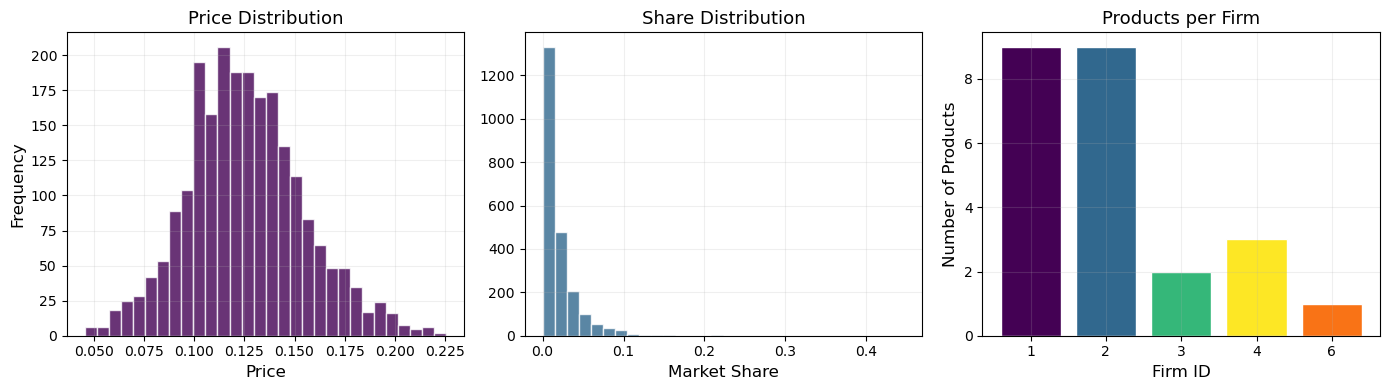
The dataset contains 24 cereal brands observed across 94 city-quarter markets. Each observation is a product-market pair with: - shares: market share of the product - prices: price per serving - sugar: sugar content - mushy: indicator for mushy cereals - demand_instruments0–19: pre-computed BLP instruments - firm_ids: 5 firms (think Kellogg’s, General Mills, etc.) - product_ids: 24 brand identifiers

# Load product-level data
product_data = pd.read_csv(pyblp.data.NEVO_PRODUCTS_LOCATION)

print(f'Shape: {product_data.shape}')
print(f'Markets: {product_data["market_ids"].nunique()}')
print(f'Products: {product_data["product_ids"].nunique()}')
print(f'Firms: {product_data["firm_ids"].nunique()}')
print()

# Key columns
product_data[['market_ids', 'product_ids', 'firm_ids', 'shares', 'prices', 'sugar', 'mushy']].head(10)
Shape: (2256, 30)
Markets: 94
Products: 24
Firms: 5
market_ids product_ids firm_ids shares prices sugar mushy
0 C01Q1 F1B04 1 0.012417 0.072088 2 1
1 C01Q1 F1B06 1 0.007809 0.114178 18 1
2 C01Q1 F1B07 1 0.012995 0.132391 4 1
3 C01Q1 F1B09 1 0.005770 0.130344 3 0
4 C01Q1 F1B11 1 0.017934 0.154823 12 0
5 C01Q1 F1B13 1 0.026602 0.137049 14 0
6 C01Q1 F1B17 1 0.025015 0.144209 3 1
7 C01Q1 F1B30 1 0.005058 0.128191 4 0
8 C01Q1 F1B45 1 0.005332 0.149611 14 0
9 C01Q1 F2B05 2 0.038068 0.108514 1 0
product_data[['prices', 'shares', 'sugar', 'mushy']].describe().round(4)
prices shares sugar mushy
count 2256.0000 2256.0000 2256.0000 2256.0000
mean 0.1257 0.0198 8.6250 0.3333
std 0.0290 0.0256 5.7879 0.4715
min 0.0455 0.0002 0.0000 0.0000
25% 0.1055 0.0052 3.0000 0.0000
50% 0.1238 0.0111 8.5000 0.0000
75% 0.1433 0.0246 13.2500 1.0000
max 0.2257 0.4469 20.0000 1.0000
fig, axes = plt.subplots(1, 3, figsize=(14, 4))

# Price distribution
axes[0].hist(product_data['prices'], bins=30, color='#440154', alpha=0.8, edgecolor='white')
axes[0].set_xlabel('Price', fontsize=12)
axes[0].set_ylabel('Frequency', fontsize=12)
axes[0].set_title('Price Distribution', fontsize=13)
axes[0].grid(True, alpha=0.2)

# Share distribution
axes[1].hist(product_data['shares'], bins=30, color='#31688e', alpha=0.8, edgecolor='white')
axes[1].set_xlabel('Market Share', fontsize=12)
axes[1].set_title('Share Distribution', fontsize=13)
axes[1].grid(True, alpha=0.2)

# Products per firm
firm_counts = product_data.groupby('firm_ids')['product_ids'].nunique()
axes[2].bar(firm_counts.index.astype(str), firm_counts.values, 
            color=['#440154', '#31688e', '#35b779', '#fde725', '#f97316'], 
            edgecolor='white')
axes[2].set_xlabel('Firm ID', fontsize=12)
axes[2].set_ylabel('Number of Products', fontsize=12)
axes[2].set_title('Products per Firm', fontsize=13)
axes[2].grid(True, alpha=0.2)

plt.tight_layout()
plt.show()

# Load agent (consumer) demographic data
agent_data = pd.read_csv(pyblp.data.NEVO_AGENTS_LOCATION)

print(f'Agent data shape: {agent_data.shape}')
print(f'Agents per market: {agent_data.groupby("market_ids").size().iloc[0]}')
print()
agent_data[['market_ids', 'weights', 'income', 'income_squared', 'age', 'child']].describe().round(4)
Agent data shape: (1880, 12)
Agents per market: 20
weights income income_squared age child
count 1880.00 1880.0000 1880.0000 1880.0000 1880.0000
mean 0.05 -0.0000 0.0000 -0.0000 0.0000
std 0.00 0.9396 16.0435 0.9446 0.4215
min 0.05 -4.9382 -65.9464 -3.2258 -0.2309
25% 0.05 -0.4282 -8.4548 -0.3926 -0.2309
50% 0.05 0.1608 2.0565 0.2399 -0.2309
75% 0.05 0.5887 10.1278 0.6454 -0.2309
max 0.05 2.3346 46.8563 1.2740 0.7691

Step 1: Plain Logit

The simplest demand model: all consumers have identical tastes (\(\Sigma = 0\), \(\Pi = 0\)). The market share equation collapses to the familiar logit:

\[ \ln s_{jt} - \ln s_{0t} = x_j' \beta - \alpha \, p_{jt} + \xi_{jt} \]

This is a linear IV regression of log share ratios on product characteristics and price. We absorb brand fixed effects (product dummies) and use the 20 pre-computed demand instruments.

# Formulation: price with product fixed effects absorbed
logit_formulation = pyblp.Formulation('prices', absorb='C(product_ids)')

logit_problem = pyblp.Problem(logit_formulation, product_data)
logit_problem
Dimensions:
================================
 T    N     F    K1    MD    ED 
---  ----  ---  ----  ----  ----
94   2256   5    1     20    1  
================================

Formulations:
==================================
     Column Indices:          0   
--------------------------  ------
X1: Linear Characteristics  prices
==================================
logit_results = logit_problem.solve()
logit_results
Problem Results Summary:
==========================================
GMM   Objective  Clipped  Weighting Matrix
Step    Value    Shares   Condition Number
----  ---------  -------  ----------------
 2    +1.9E+02      0         +5.7E+07    
==========================================

Cumulative Statistics:
========================
Computation   Objective 
   Time      Evaluations
-----------  -----------
 00:00:00         2     
========================

Beta Estimates (Robust SEs in Parentheses):
==========
  prices  
----------
 -3.0E+01 
(+1.0E+00)
==========

The price coefficient \(\hat{\alpha} \approx -30\) is large and negative: higher prices reduce market share. But the plain logit imposes the IIA property — substitution patterns are proportional to market shares, regardless of product similarity. This is unrealistic: if Cheerios’ price rises, consumers are more likely to switch to similar cereals than to very different ones.

# Compute own-price elasticities
logit_elasticities = logit_results.compute_elasticities()

# Extract own-price elasticities (diagonal)
logit_own = logit_results.extract_diagonal_means(logit_elasticities)

print(f'Logit own-price elasticities:')
print(f'  Mean: {logit_own.mean():.3f}')
print(f'  Range: [{logit_own.min():.3f}, {logit_own.max():.3f}]')
Logit own-price elasticities:
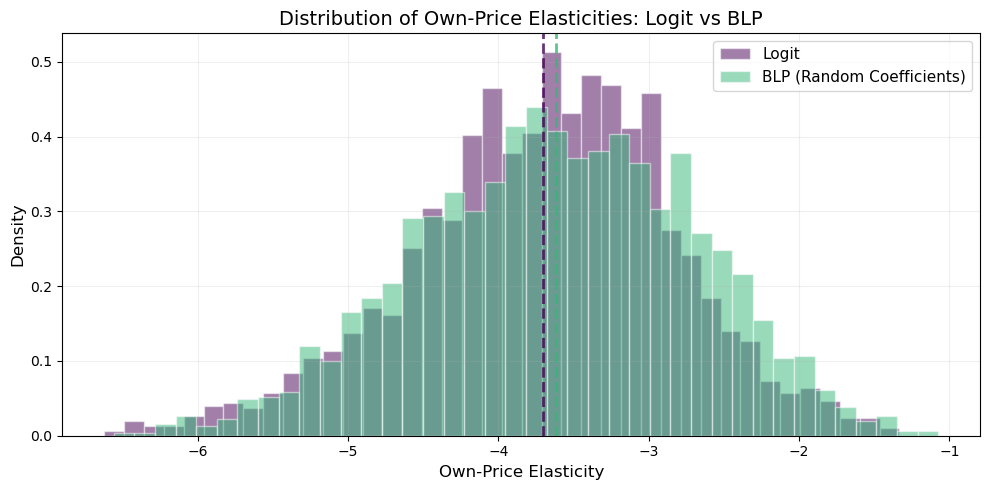
  Mean: -3.706
  Range: [-4.052, -3.289]

Step 2: Random Coefficients Logit (BLP)

Now we add heterogeneous preferences via random coefficients on the constant (inside vs. outside good), price, sugar, and mushy. This breaks IIA: products with similar characteristics become closer substitutes.

We need two formulations: - X1 (linear, \(\bar{\beta}\)): variables entering mean utility — price + product fixed effects - X2 (nonlinear, \(\Sigma\)): variables receiving random coefficients — constant, price, sugar, mushy

Plus an agent formulation for demographics: income, income\(^2\), age, child.

# X1: linear parameters (price + brand FE)
X1 = pyblp.Formulation('0 + prices', absorb='C(product_ids)')

# X2: random coefficient variables
X2 = pyblp.Formulation('1 + prices + sugar + mushy')

# Agent demographics formulation
agent_formulation = pyblp.Formulation('0 + income + income_squared + age + child')

# Build the problem
blp_problem = pyblp.Problem(
    (X1, X2),
    product_data,
    agent_formulation,
    agent_data,
)
blp_problem
Dimensions:
=================================================
 T    N     F    I     K1    K2    D    MD    ED 
---  ----  ---  ----  ----  ----  ---  ----  ----
94   2256   5   1880   1     4     4    20    1  
=================================================

Formulations:
===================================================================
       Column Indices:           0           1           2      3  
-----------------------------  ------  --------------  -----  -----
 X1: Linear Characteristics    prices                              
X2: Nonlinear Characteristics    1         prices      sugar  mushy
       d: Demographics         income  income_squared   age   child
===================================================================

Initial Values & Solving

The nonlinear GMM objective is non-convex, so starting values matter. We use values close to Nevo (2000)’s published estimates:

  • \(\Sigma_0\) = diagonal matrix of standard deviations for (constant, price, sugar, mushy)
  • \(\Pi_0\) = matrix of demographic interactions

Zeros in \(\Sigma_0\) or \(\Pi_0\) are constrained to remain zero during optimization — this is how you restrict the model.

# Initial sigma (diagonal: std devs for constant, price, sugar, mushy)
initial_sigma = np.diag([0.3302, 2.4526, 0.0163, 0.2441])

# Initial pi (K2 x D demographics interaction matrix)
# Rows: constant, price, sugar, mushy
# Cols: income, income_squared, age, child
initial_pi = np.array([
    [ 5.4819,  0,       0.2037,  0     ],
    [15.8935, -1.2000,  0,       2.6342],
    [-0.2506,  0,       0.0511,  0     ],
    [ 1.2650,  0,      -0.8091,  0     ],
])

# Solve with BFGS optimizer, 1-step GMM
blp_results = blp_problem.solve(
    initial_sigma,
    initial_pi,
    optimization=pyblp.Optimization('bfgs', {'gtol': 1e-5}),
    method='1s',
)
blp_results
Problem Results Summary:
=======================================================================================================
GMM   Objective  Gradient      Hessian         Hessian     Clipped  Weighting Matrix  Covariance Matrix
Step    Value      Norm    Min Eigenvalue  Max Eigenvalue  Shares   Condition Number  Condition Number 
----  ---------  --------  --------------  --------------  -------  ----------------  -----------------
 1    +4.6E+00   +6.9E-06     +2.3E-05        +1.6E+04        0         +6.9E+07          +8.4E+08     
=======================================================================================================

Cumulative Statistics:
===========================================================================
Computation  Optimizer  Optimization   Objective   Fixed Point  Contraction
   Time      Converged   Iterations   Evaluations  Iterations   Evaluations
-----------  ---------  ------------  -----------  -----------  -----------
 00:00:18       Yes          51           57          46371       143944   
===========================================================================

Nonlinear Coefficient Estimates (Robust SEs in Parentheses):
=====================================================================================================================
Sigma:      1         prices      sugar       mushy     |   Pi:      income    income_squared     age        child   
------  ----------  ----------  ----------  ----------  |  ------  ----------  --------------  ----------  ----------
  1      +5.6E-01                                       |    1      +2.3E+00      +0.0E+00      +1.3E+00    +0.0E+00 
        (+1.6E-01)                                      |          (+1.2E+00)                  (+6.3E-01)            
                                                        |                                                            
prices   +0.0E+00    +3.3E+00                           |  prices   +5.9E+02      -3.0E+01      +0.0E+00    +1.1E+01 
                    (+1.3E+00)                          |          (+2.7E+02)    (+1.4E+01)                (+4.1E+00)
                                                        |                                                            
sugar    +0.0E+00    +0.0E+00    -5.8E-03               |  sugar    -3.8E-01      +0.0E+00      +5.2E-02    +0.0E+00 
                                (+1.4E-02)              |          (+1.2E-01)                  (+2.6E-02)            
                                                        |                                                            
mushy    +0.0E+00    +0.0E+00    +0.0E+00    +9.3E-02   |  mushy    +7.5E-01      +0.0E+00      -1.4E+00    +0.0E+00 
                                            (+1.9E-01)  |          (+8.0E-01)                  (+6.7E-01)            
=====================================================================================================================

Beta Estimates (Robust SEs in Parentheses):
==========
  prices  
----------
 -6.3E+01 
(+1.5E+01)
==========

Interpreting the results:

  • \(\hat{\Sigma}\) (Sigma): the Cholesky root of the unobserved heterogeneity covariance. Diagonal elements give the std dev of random coefficients.
  • \(\hat{\Pi}\) (Pi): how demographics shift tastes. E.g., \(\Pi_{\text{price, income}} > 0\) means higher-income consumers are less price-sensitive.
  • \(\hat{\beta}\) (Beta): the mean price coefficient (from X1).
  • The GMM objective value measures fit; the weighting matrix condition number flags numerical issues.

Post-Estimation Analysis

Own-Price Elasticities

The own-price elasticity measures the percentage change in market share for a 1% price increase:

\[ \varepsilon_{jj} = \frac{\partial s_j}{\partial p_j} \cdot \frac{p_j}{s_j} \]

With random coefficients, these vary across products and markets (unlike logit, where \(\varepsilon_{jj} \approx \alpha \, p_j (1 - s_j)\) for all products).

# Compute full elasticity matrices (J x J for each market)
elasticities = blp_results.compute_elasticities()

# Extract own-price elasticities (diagonal of each market's matrix)
own_elasticities = blp_results.extract_diagonal_means(elasticities)

print(f'BLP own-price elasticities:')
print(f'  Mean:   {own_elasticities.mean():.3f}')
print(f'  Median: {np.median(own_elasticities):.3f}')
print(f'  Std:    {own_elasticities.std():.3f}')
print(f'  Range:  [{own_elasticities.min():.3f}, {own_elasticities.max():.3f}]')
BLP own-price elasticities:
  Mean:   -3.618
  Median: -3.591
  Std:    0.300
  Range:  [-4.354, -3.073]
fig, ax = plt.subplots(figsize=(10, 5))

# Logit own-price elasticities (all products across markets)
logit_diag = []
market_ids = product_data['market_ids'].unique()
idx = 0
for m in market_ids:
    n_j = (product_data['market_ids'] == m).sum()
    mat = logit_elasticities[idx:idx+n_j]
    logit_diag.extend(np.diag(mat).tolist())
    idx += n_j

# BLP own-price elasticities (same extraction)
blp_diag = []
idx = 0
for m in market_ids:
    n_j = (product_data['market_ids'] == m).sum()
    mat = elasticities[idx:idx+n_j]
    blp_diag.extend(np.diag(mat).tolist())
    idx += n_j

ax.hist(logit_diag, bins=40, alpha=0.5, color='#440154', label='Logit', density=True, edgecolor='white')
ax.hist(blp_diag, bins=40, alpha=0.5, color='#35b779', label='BLP (Random Coefficients)', density=True, edgecolor='white')
ax.axvline(np.mean(logit_diag), color='#440154', linestyle='--', linewidth=2, alpha=0.8)
ax.axvline(np.mean(blp_diag), color='#35b779', linestyle='--', linewidth=2, alpha=0.8)

ax.set_xlabel('Own-Price Elasticity', fontsize=12)
ax.set_ylabel('Density', fontsize=12)
ax.set_title('Distribution of Own-Price Elasticities: Logit vs BLP', fontsize=14)
ax.legend(fontsize=11)
ax.grid(True, alpha=0.2)

plt.tight_layout()
plt.show()

Cross-Price Elasticity Heatmap

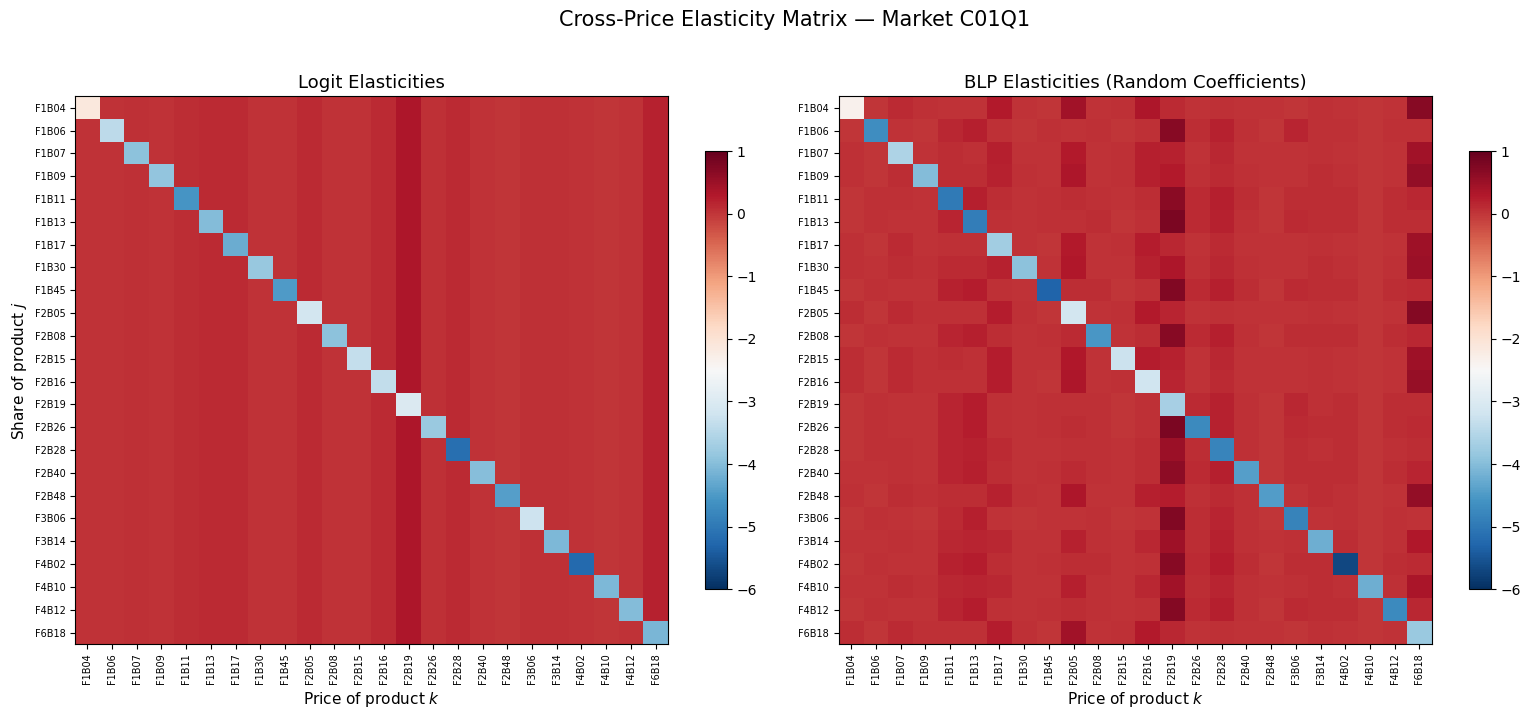
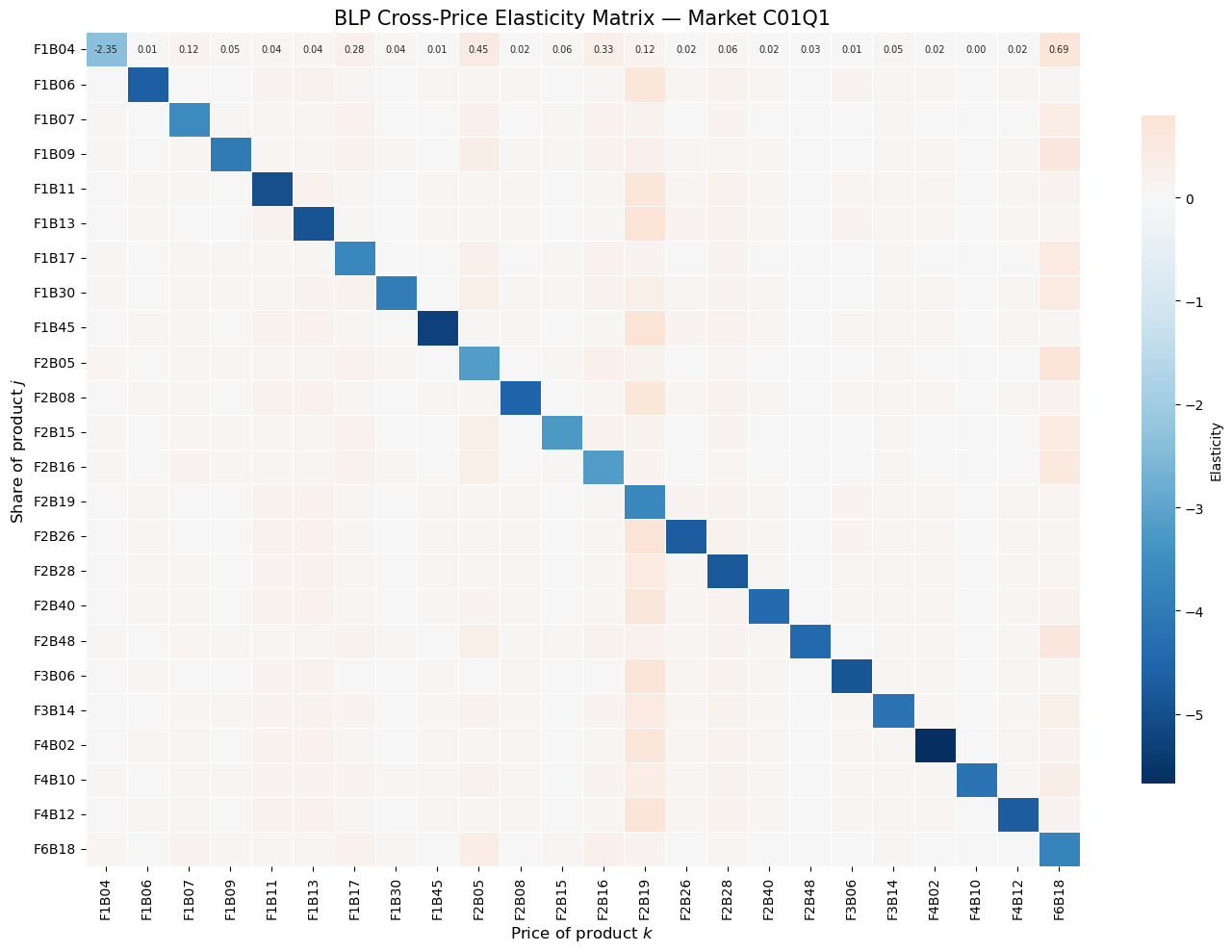
The cross-price elasticity \(\varepsilon_{jk} = \frac{\partial s_j}{\partial p_k} \cdot \frac{p_k}{s_j}\) measures how product \(j\)’s share responds to a change in product \(k\)’s price.

Under logit, all cross-elasticities with respect to product \(k\) are proportional to \(s_k\) — substitution is driven purely by market share, not similarity. Under BLP, cross-elasticities reflect product similarity through the random coefficients, producing richer substitution patterns.

# Pick a single market
market = 'C01Q1'
market_mask = product_data['market_ids'] == market
n_products = market_mask.sum()
product_labels = product_data.loc[market_mask, 'product_ids'].values

# Extract elasticity matrix for this market
market_idx = np.where(market_mask)[0]
start = market_idx[0]
elast_matrix_logit = logit_elasticities[start:start+n_products, :n_products]
elast_matrix_blp = elasticities[start:start+n_products, :n_products]

fig, axes = plt.subplots(1, 2, figsize=(16, 7))

# Logit
im1 = axes[0].imshow(elast_matrix_logit, cmap='RdBu_r', aspect='auto', 
                      vmin=-6, vmax=1)
axes[0].set_xticks(range(n_products))
axes[0].set_yticks(range(n_products))
axes[0].set_xticklabels(product_labels, rotation=90, fontsize=7)
axes[0].set_yticklabels(product_labels, fontsize=7)
axes[0].set_title('Logit Elasticities', fontsize=13)
axes[0].set_xlabel('Price of product $k$', fontsize=11)
axes[0].set_ylabel('Share of product $j$', fontsize=11)
plt.colorbar(im1, ax=axes[0], shrink=0.8)

# BLP
im2 = axes[1].imshow(elast_matrix_blp, cmap='RdBu_r', aspect='auto', 
                      vmin=-6, vmax=1)
axes[1].set_xticks(range(n_products))
axes[1].set_yticks(range(n_products))
axes[1].set_xticklabels(product_labels, rotation=90, fontsize=7)
axes[1].set_yticklabels(product_labels, fontsize=7)
axes[1].set_title('BLP Elasticities (Random Coefficients)', fontsize=13)
axes[1].set_xlabel('Price of product $k$', fontsize=11)
plt.colorbar(im2, ax=axes[1], shrink=0.8)

plt.suptitle(f'Cross-Price Elasticity Matrix — Market {market}', fontsize=15, y=1.02)
plt.tight_layout()
plt.show()

# Seaborn heatmap with annotations for BLP cross-elasticities
elast_df = pd.DataFrame(
    elast_matrix_blp, 
    index=product_labels, 
    columns=product_labels
)

fig, ax = plt.subplots(figsize=(14, 10))
sns.heatmap(
    elast_df, 
    cmap='RdBu_r', 
    center=0, 
    annot=True, 
    fmt='.2f', 
    linewidths=0.5,
    linecolor='white',
    annot_kws={'size': 7},
    cbar_kws={'label': 'Elasticity', 'shrink': 0.8},
    ax=ax,
)
ax.set_title(f'BLP Cross-Price Elasticity Matrix — Market {market}', fontsize=15)
ax.set_xlabel('Price of product $k$', fontsize=12)
ax.set_ylabel('Share of product $j$', fontsize=12)

plt.tight_layout()
plt.show()

Diversion Ratios

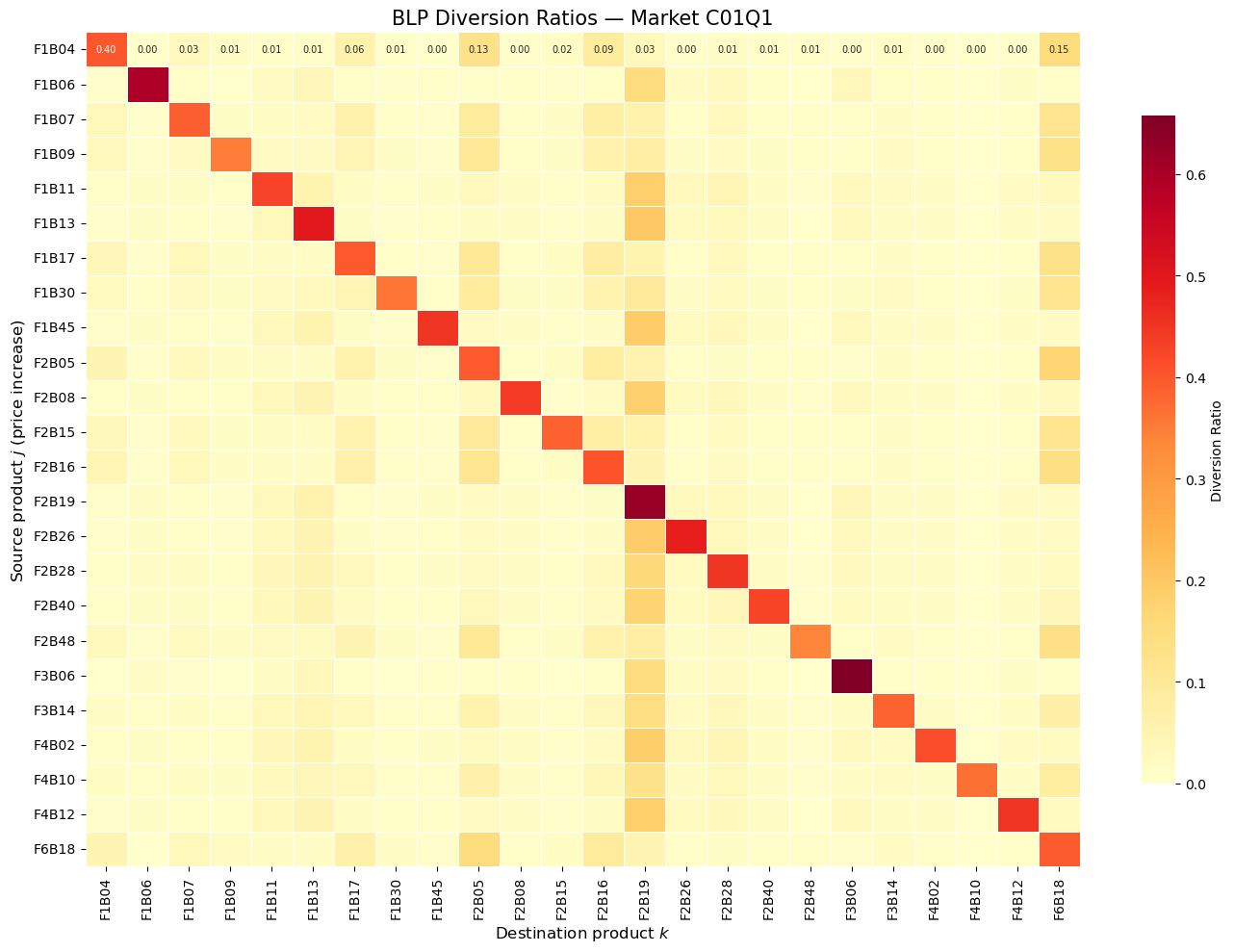
The diversion ratio from product \(j\) to product \(k\) measures what fraction of \(j\)’s lost sales go to \(k\) when \(j\)’s price increases:

\[ D_{jk} = -\frac{\partial s_k / \partial p_j}{\partial s_j / \partial p_j} \]

Diversion ratios are central to merger analysis: if two merging firms’ products have high diversion ratios to each other, the merger raises greater competitive concerns.

# Compute diversion ratios
diversions = blp_results.compute_diversion_ratios()

# Extract for our market
div_matrix = diversions[start:start+n_products, :n_products]

div_df = pd.DataFrame(div_matrix, index=product_labels, columns=product_labels)

fig, ax = plt.subplots(figsize=(14, 10))
sns.heatmap(
    div_df, 
    cmap='YlOrRd', 
    annot=True, 
    fmt='.2f', 
    linewidths=0.5,
    linecolor='white',
    annot_kws={'size': 7},
    cbar_kws={'label': 'Diversion Ratio', 'shrink': 0.8},
    vmin=0,
    ax=ax,
)
ax.set_title(f'BLP Diversion Ratios — Market {market}', fontsize=15)
ax.set_xlabel('Destination product $k$', fontsize=12)
ax.set_ylabel('Source product $j$ (price increase)', fontsize=12)

plt.tight_layout()
plt.show()

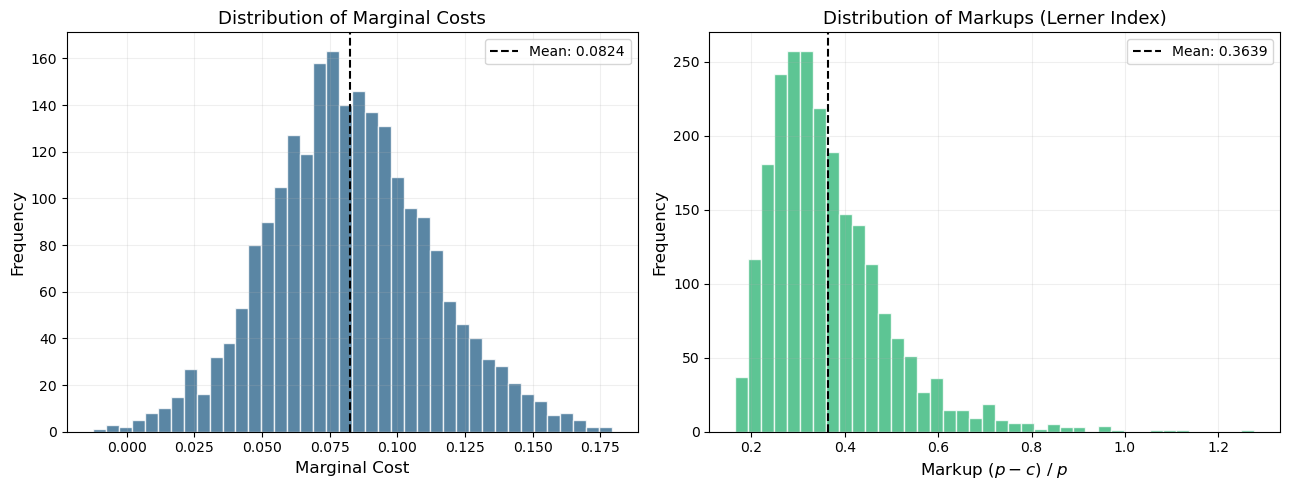
Marginal Costs & Markups

Given estimated demand and the assumption of multi-product Bertrand-Nash pricing, we can back out implied marginal costs from the first-order conditions:

\[ p = c + \underbrace{(\Omega \odot \Delta)^{-1} s}_{\text{markup}} \]

where \(\Omega\) is the ownership matrix and \(\Delta_{jk} = -\partial s_k / \partial p_j\) is the demand Jacobian.

# Compute marginal costs and markups
costs = blp_results.compute_costs()
markups = blp_results.compute_markups(costs=costs)

fig, axes = plt.subplots(1, 2, figsize=(13, 5))

# Marginal costs
axes[0].hist(costs.flatten(), bins=40, color='#31688e', alpha=0.8, edgecolor='white')
axes[0].axvline(costs.mean(), color='black', linestyle='--', linewidth=1.5, 
                label=f'Mean: {costs.mean():.4f}')
axes[0].set_xlabel('Marginal Cost', fontsize=12)
axes[0].set_ylabel('Frequency', fontsize=12)
axes[0].set_title('Distribution of Marginal Costs', fontsize=13)
axes[0].legend(fontsize=10)
axes[0].grid(True, alpha=0.2)

# Markups
axes[1].hist(markups.flatten(), bins=40, color='#35b779', alpha=0.8, edgecolor='white')
axes[1].axvline(markups.mean(), color='black', linestyle='--', linewidth=1.5,
                label=f'Mean: {markups.mean():.4f}')
axes[1].set_xlabel('Markup ($p - c$) / $p$', fontsize=12)
axes[1].set_ylabel('Frequency', fontsize=12)
axes[1].set_title('Distribution of Markups (Lerner Index)', fontsize=13)
axes[1].legend(fontsize=10)
axes[1].grid(True, alpha=0.2)

plt.tight_layout()
plt.show()

print(f'Marginal cost — Mean: {costs.mean():.4f}, Median: {np.median(costs):.4f}')
print(f'Markup (Lerner) — Mean: {markups.mean():.4f}, Median: {np.median(markups):.4f}')

Marginal cost — Mean: 0.0824, Median: 0.0812
Markup (Lerner) — Mean: 0.3639, Median: 0.3371

Merger Simulation

A core application of BLP: simulate the price effects of a hypothetical merger. The idea is simple:

  1. Estimate demand and recover pre-merger marginal costs \(c_j\)
  2. Change the ownership matrix \(\Omega\) to reflect the merger (merging firms now internalize pricing externalities)
  3. Solve for new Nash equilibrium prices given the new \(\Omega\) but the same \(c_j\)
  4. Compare pre-merger vs. post-merger outcomes

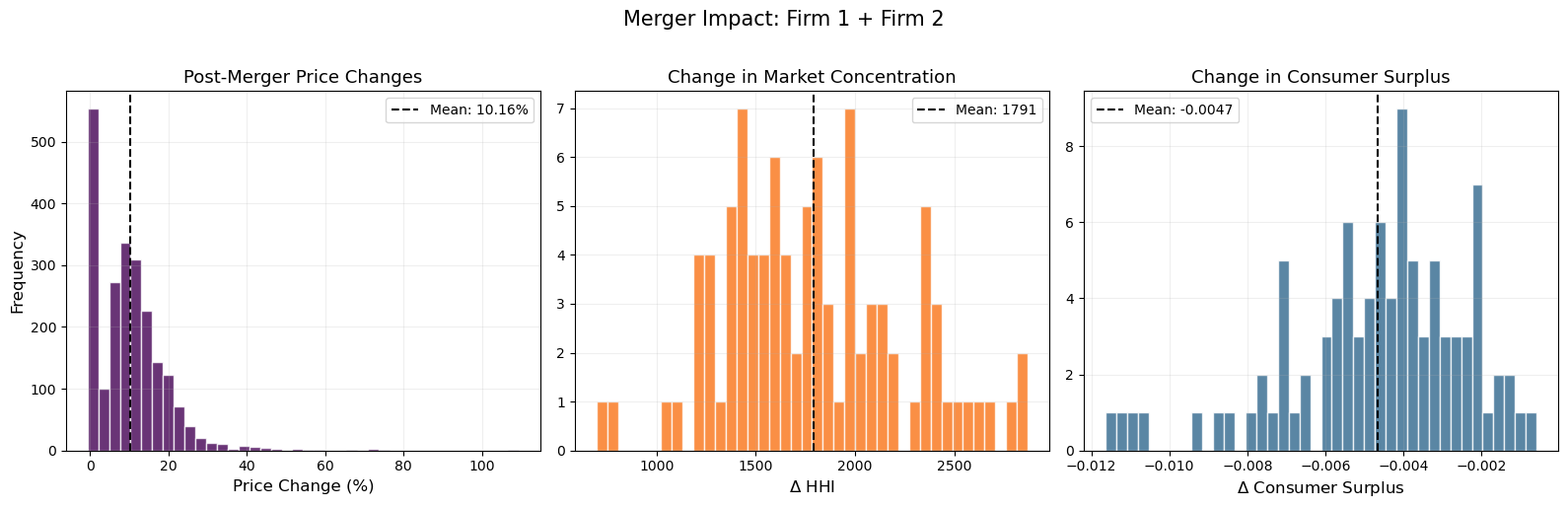
We simulate a merger between Firm 1 and Firm 2 (the two largest firms, with 9 products each).

# Create post-merger firm IDs: Firm 2 becomes part of Firm 1
product_data['merger_ids'] = product_data['firm_ids'].replace(2, 1)

print('Pre-merger firm structure:')
print(product_data.groupby('firm_ids')['product_ids'].nunique().to_string())
print()
print('Post-merger firm structure:')
print(product_data.groupby('merger_ids')['product_ids'].nunique().to_string())
Pre-merger firm structure:
firm_ids
1    9
2    9
3    2
4    3
6    1

Post-merger firm structure:
merger_ids
1    18
3     2
4     3
6     1
# Pre-merger benchmarks
pre_hhi = blp_results.compute_hhi()
pre_profits = blp_results.compute_profits(costs=costs)
pre_cs = blp_results.compute_consumer_surpluses()

# Post-merger equilibrium prices
post_prices = blp_results.compute_prices(
    firm_ids=product_data['merger_ids'],
    costs=costs,
)

# Post-merger outcomes
post_shares = blp_results.compute_shares(post_prices)
post_hhi = blp_results.compute_hhi(
    firm_ids=product_data['merger_ids'],
    shares=post_shares,
)
post_markups = blp_results.compute_markups(post_prices, costs=costs)
post_profits = blp_results.compute_profits(post_prices, post_shares, costs)
post_cs = blp_results.compute_consumer_surpluses(post_prices)

# Price changes
price_changes = (post_prices - product_data['prices'].values.reshape(-1, 1)) / product_data['prices'].values.reshape(-1, 1) * 100

print(f'=== Merger Simulation: Firm 1 + Firm 2 ===')
print(f'Price change (%):     Mean = {price_changes.mean():.2f}%, Median = {np.median(price_changes):.2f}%')
print(f'HHI change:           Mean = {(post_hhi - pre_hhi).mean():.1f}')
print(f'Consumer surplus ($/person):')
print(f'  Pre-merger:  {pre_cs.mean():.4f}')
print(f'  Post-merger: {post_cs.mean():.4f}')
print(f'  Change:      {(post_cs - pre_cs).mean():.4f}')
=== Merger Simulation: Firm 1 + Firm 2 ===
Price change (%):     Mean = 10.16%, Median = 9.41%
HHI change:           Mean = 1790.8
Consumer surplus ($/person):
  Pre-merger:  0.0342
  Post-merger: 0.0296
  Change:      -0.0047
fig, axes = plt.subplots(1, 3, figsize=(16, 5))

# Price changes
axes[0].hist(price_changes.flatten(), bins=40, color='#440154', alpha=0.8, edgecolor='white')
axes[0].axvline(price_changes.mean(), color='black', linestyle='--', linewidth=1.5,
                label=f'Mean: {price_changes.mean():.2f}%')
axes[0].set_xlabel('Price Change (%)', fontsize=12)
axes[0].set_ylabel('Frequency', fontsize=12)
axes[0].set_title('Post-Merger Price Changes', fontsize=13)
axes[0].legend(fontsize=10)
axes[0].grid(True, alpha=0.2)

# HHI changes
hhi_change = (post_hhi - pre_hhi).flatten()
axes[1].hist(hhi_change, bins=40, color='#f97316', alpha=0.8, edgecolor='white')
axes[1].axvline(hhi_change.mean(), color='black', linestyle='--', linewidth=1.5,
                label=f'Mean: {hhi_change.mean():.0f}')
axes[1].set_xlabel('$\Delta$ HHI', fontsize=12)
axes[1].set_title('Change in Market Concentration', fontsize=13)
axes[1].legend(fontsize=10)
axes[1].grid(True, alpha=0.2)

# Consumer surplus changes
cs_change = (post_cs - pre_cs).flatten()
axes[2].hist(cs_change, bins=40, color='#31688e', alpha=0.8, edgecolor='white')
axes[2].axvline(cs_change.mean(), color='black', linestyle='--', linewidth=1.5,
                label=f'Mean: {cs_change.mean():.4f}')
axes[2].set_xlabel('$\Delta$ Consumer Surplus', fontsize=12)
axes[2].set_title('Change in Consumer Surplus', fontsize=13)
axes[2].legend(fontsize=10)
axes[2].grid(True, alpha=0.2)

plt.suptitle('Merger Impact: Firm 1 + Firm 2', fontsize=15, y=1.02)
plt.tight_layout()
plt.show()

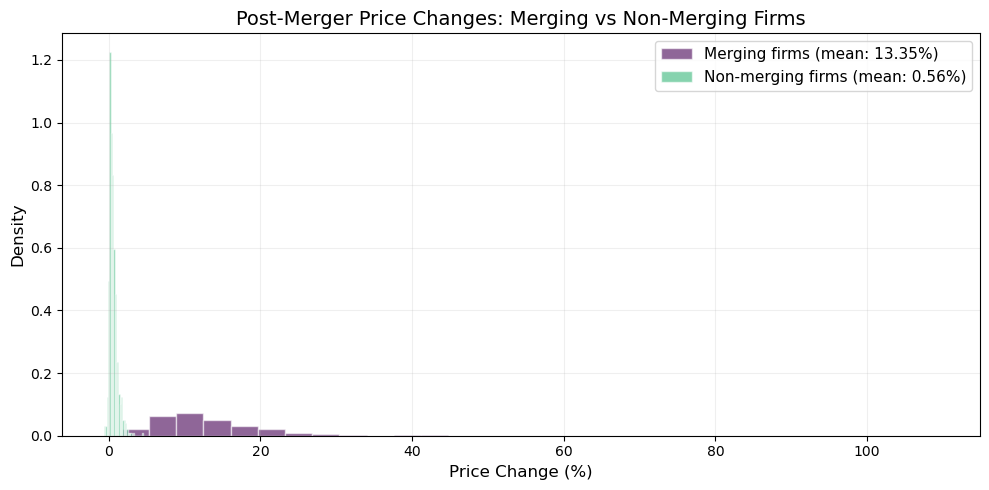
# Price changes by firm (who benefits from the merger?)
price_change_df = pd.DataFrame({
    'firm_id': product_data['firm_ids'],
    'product_id': product_data['product_ids'],
    'pre_price': product_data['prices'],
    'post_price': post_prices.flatten(),
    'price_change_pct': price_changes.flatten(),
    'merging': product_data['firm_ids'].isin([1, 2]),
})

fig, ax = plt.subplots(figsize=(10, 5))

merging = price_change_df[price_change_df['merging']]
non_merging = price_change_df[~price_change_df['merging']]

ax.hist(merging['price_change_pct'], bins=30, alpha=0.6, color='#440154', 
        label=f'Merging firms (mean: {merging["price_change_pct"].mean():.2f}%)', 
        density=True, edgecolor='white')
ax.hist(non_merging['price_change_pct'], bins=30, alpha=0.6, color='#35b779', 
        label=f'Non-merging firms (mean: {non_merging["price_change_pct"].mean():.2f}%)', 
        density=True, edgecolor='white')

ax.set_xlabel('Price Change (%)', fontsize=12)
ax.set_ylabel('Density', fontsize=12)
ax.set_title('Post-Merger Price Changes: Merging vs Non-Merging Firms', fontsize=14)
ax.legend(fontsize=11)
ax.grid(True, alpha=0.2)

plt.tight_layout()
plt.show()

Micro Moments: Incorporating Individual-Level Data

Demographics vs. Micro Moments

A common point of confusion: the agent demographics we used above (\(d_i\) = income, age, child) are not micro moments. They play very different roles:

Agent Demographics (\(\Pi d_i\)) Micro Moments
What they are Draws from the population distribution of consumer types Empirical statistics computed from individual-level survey data
Role in estimation Define the integration measure for computing predicted shares Provide additional moment conditions in the GMM objective
What they match Nothing directly — they specify how to integrate over heterogeneity Match model-predicted statistics to observed survey statistics
Example “20 draws of (income, age) per market, used to approximate the share integral” “The average income of consumers who bought brand X is $45,000”
Identification Help compute \(s_j(\delta, \theta_2)\) but don’t add moment conditions Add new moments \(\bar{g}_M\) that help pin down \(\Sigma\) and \(\Pi\)

Key insight: In the standard BLP setup, the only moments matched are the demand-side conditions \(\mathbb{E}[Z'\xi] = 0\) (instruments orthogonal to the structural error). Demographics help compute predicted shares, but they don’t provide additional data to match. Micro moments add extra targets: they say “the model must also predict that the average age of mushy cereal buyers is 35 and that high-income consumers are 20% more likely to buy premium brands.”

The Math

The standard BLP GMM stacks demand (and possibly supply) moments:

\[ \bar{g} = \begin{bmatrix} \bar{g}_D \end{bmatrix} = \begin{bmatrix} Z'\xi(\theta) / N \end{bmatrix} \]

With micro moments, we augment the moment vector:

\[ \bar{g} = \begin{bmatrix} \bar{g}_D \\ \bar{g}_M \end{bmatrix}, \quad \bar{g}_{M,m} = f_m(\bar{v}) - f_m(v(\theta)) \]

where \(f_m(\bar{v})\) is the observed statistic from survey data (e.g., \(\mathbb{E}[\text{income} \mid \text{bought mushy cereal}] = 0.35\)) and \(f_m(v(\theta))\) is the model-predicted equivalent.

Each micro moment part \(v_p\) is a weighted average over agents, products, and markets:

\[ v_p(\theta) = \frac{\sum_{t} \sum_{i \in I_t} \sum_{j \in J_t \cup \{0\}} w_{it} \, s_{ijt}(\theta) \, w^d_{pijt} \, v_{pijt}}{\sum_{t} \sum_{i \in I_t} \sum_{j \in J_t \cup \{0\}} w_{it} \, s_{ijt}(\theta) \, w^d_{pijt}} \]

where \(s_{ijt}(\theta)\) is the model-predicted probability that agent \(i\) buys product \(j\) in market \(t\), and \(w^d_{pijt}\) and \(v_{pijt}\) are dataset-specific weights and values.

Types of Micro Data

Common sources of micro moments include:

  1. Consumer surveys (e.g., Consumer Expenditure Survey): “What is the average income of buyers of product category X?”
  2. Scanner data with demographics: “What fraction of high-income households buy premium brands?”
  3. Second-choice data: “Among consumers who bought brand A, what fraction would have bought brand B as their second choice?” (very powerful for identifying substitution patterns)
  4. Purchase probabilities by segment: “What is the probability a household with children buys a sugary cereal?”

Why Micro Moments Help

Market-level shares alone may not strongly identify the nonlinear parameters \((\Sigma, \Pi)\). Many combinations of \((\Sigma, \Pi)\) can generate similar aggregate shares. Micro moments break this degeneracy by providing additional targets:

  • \(\Sigma\) identification: Conditional purchase probabilities by product type pin down how much unobserved heterogeneity there is.
  • \(\Pi\) identification: Conditional demographic means (e.g., average age of mushy cereal buyers) directly inform how demographics shift tastes.
  • Substitution patterns: Second-choice data directly constrains cross-elasticities, which are otherwise weakly identified from shares alone.

Example: Micro Moments with Nevo Data

Since we don’t have real survey data for these cereals, we’ll use a practical workflow: simulate micro data from our estimated model, then use those simulated statistics as targets for re-estimation. This demonstrates the full PyBLP micro moments API.

The idea: use simulate_micro_data() to generate individual-level purchase records consistent with our estimates, compute statistics from them, then pass those as micro moment targets.

We’ll construct two types of micro moments: 1. Conditional demographic means: \(\mathbb{E}[\text{income} \mid \text{bought mushy cereal}]\) 2. Purchase probability by segment: \(\mathbb{E}[\mathbf{1}\{\text{bought any cereal}\} \mid \text{has children}]\)

# Step 1: Define a micro dataset
# This represents a hypothetical consumer survey of 5,000 observations
# compute_weights returns a (I_t x 1+J_t) matrix of sampling weights
# Here: all agent-product pairs are equally likely to be sampled
micro_dataset = pyblp.MicroDataset(
    name="Consumer Survey",
    observations=5000,
    compute_weights=lambda t, p, a: np.ones((a.size, 1 + p.size)),
)

# Step 2: Simulate micro data from our BLP estimates
# This generates individual purchase records consistent with the model
micro_data = blp_results.simulate_micro_data(dataset=micro_dataset, seed=42)
micro_df = pd.DataFrame(pyblp.data_to_dict(micro_data))

print(f'Simulated micro data: {micro_df.shape[0]} observations')
print(f'Columns: {list(micro_df.columns)}')
print(f'Outside option (choice=0): {(micro_df["choice_indices"] == 0).sum()} / {len(micro_df)}')
micro_df.head()
Simulated micro data: 5000 observations
Columns: ['micro_ids', 'market_ids', 'agent_indices', 'choice_indices']
Outside option (choice=0): 2594 / 5000
micro_ids market_ids agent_indices choice_indices
0 0 C26Q2 4 2
1 1 C61Q2 7 0
2 2 C45Q1 16 0
3 3 C38Q1 5 11
4 4 C12Q1 13 0
# Step 3: Compute target statistics from simulated micro data
# In practice, these would come from a real consumer survey (e.g., CEX, Nielsen).
# Here we merge the simulated purchase records with agent demographics and
# product characteristics to compute conditional means.

# Add agent demographics
agent_indexed = agent_data.copy()
agent_indexed['agent_idx'] = agent_indexed.groupby('market_ids').cumcount()
micro_enriched = micro_df.merge(
    agent_indexed[['market_ids', 'agent_idx', 'income', 'age', 'child']],
    left_on=['market_ids', 'agent_indices'],
    right_on=['market_ids', 'agent_idx'],
    how='left',
)

# Add product characteristics (choice_indices: 0 = outside, 1-24 = inside products)
prod_indexed = product_data.copy()
prod_indexed['prod_idx'] = prod_indexed.groupby('market_ids').cumcount() + 1
micro_enriched = micro_enriched.merge(
    prod_indexed[['market_ids', 'prod_idx', 'sugar', 'mushy']],
    left_on=['market_ids', 'choice_indices'],
    right_on=['market_ids', 'prod_idx'],
    how='left',
)
micro_enriched['sugar'] = micro_enriched['sugar'].fillna(0)
micro_enriched['mushy'] = micro_enriched['mushy'].fillna(0)

# Compute conditional means — these are our "survey statistics"
buyers_mushy = micro_enriched[micro_enriched['mushy'] == 1]
buyers_sugary = micro_enriched[micro_enriched['sugar'] > 10]

target_income_mushy = buyers_mushy['income'].mean()
target_income_sugary = buyers_sugary['income'].mean()
target_age_mushy = buyers_mushy['age'].mean()

print("Target statistics from simulated micro data:")
print(f"  E[income | mushy cereal]:  {target_income_mushy:.4f}  (n={len(buyers_mushy)})")
print(f"  E[income | sugary cereal]: {target_income_sugary:.4f}  (n={len(buyers_sugary)})")
print(f"  E[age | mushy cereal]:     {target_age_mushy:.4f}  (n={len(buyers_mushy)})")
Target statistics from simulated micro data:
  E[income | mushy cereal]:  0.4387  (n=874)
  E[income | sugary cereal]: 0.1991  (n=1344)
  E[age | mushy cereal]:     -0.0636  (n=874)
# Step 4: Define MicroParts and assemble MicroMoments
#
# Each conditional moment E[X|Y] = E[X*Y] / E[Y] requires:
#   - A numerator MicroPart computing E[X_i * Y_j] across (agent, product) pairs
#   - A denominator MicroPart computing E[Y_j]
#
# compute_values returns an (I_t x 1+J_t) matrix:
#   - rows = agents (I_t per market)
#   - cols = outside option (col 0) + J_t inside products
#   - np.r_[0, ...] prepends a 0 for the outside option

# --- MicroParts ---
# Numerator: income_i * mushy_j
income_mushy_part = pyblp.MicroPart(
    name="E[income * mushy]", dataset=micro_dataset,
    compute_values=lambda t, p, a: np.outer(
        a.demographics[:, 0],     # income
        np.r_[0, p.X2[:, 3]],     # mushy indicators (0 for outside option)
    ),
)
# Denominator: mushy_j
mushy_part = pyblp.MicroPart(
    name="E[mushy]", dataset=micro_dataset,
    compute_values=lambda t, p, a: np.outer(
        np.ones(a.size),
        np.r_[0, p.X2[:, 3]],
    ),
)
# Numerator: income_i * high_sugar_j
income_sugary_part = pyblp.MicroPart(
    name="E[income * high_sugar]", dataset=micro_dataset,
    compute_values=lambda t, p, a: np.outer(
        a.demographics[:, 0],
        np.r_[0, (p.X2[:, 2] > 10).astype(float)],
    ),
)
# Denominator: high_sugar_j
sugary_part = pyblp.MicroPart(
    name="E[high_sugar]", dataset=micro_dataset,
    compute_values=lambda t, p, a: np.outer(
        np.ones(a.size),
        np.r_[0, (p.X2[:, 2] > 10).astype(float)],
    ),
)
# Numerator: age_i * mushy_j
age_mushy_part = pyblp.MicroPart(
    name="E[age * mushy]", dataset=micro_dataset,
    compute_values=lambda t, p, a: np.outer(
        a.demographics[:, 2],     # age
        np.r_[0, p.X2[:, 3]],
    ),
)

# --- Assemble MicroMoments ---
# Helper for conditional expectation: f(v) = v[0] / v[1]
compute_ratio = lambda v: v[0] / v[1]
compute_ratio_gradient = lambda v: [1 / v[1], -v[0] / v[1]**2]

micro_moments = [
    pyblp.MicroMoment(
        name="E[income | mushy cereal]",
        value=target_income_mushy,
        parts=[income_mushy_part, mushy_part],
        compute_value=compute_ratio,
        compute_gradient=compute_ratio_gradient,
    ),
    pyblp.MicroMoment(
        name="E[income | sugary cereal]",
        value=target_income_sugary,
        parts=[income_sugary_part, sugary_part],
        compute_value=compute_ratio,
        compute_gradient=compute_ratio_gradient,
    ),
    pyblp.MicroMoment(
        name="E[age | mushy cereal]",
        value=target_age_mushy,
        parts=[age_mushy_part, mushy_part],
        compute_value=compute_ratio,
        compute_gradient=compute_ratio_gradient,
    ),
]

print(f"{len(micro_moments)} micro moments configured:")
for mm in micro_moments:
    print(f"  {mm.name}: target = {mm.value:.4f}")
3 micro moments configured:
  E[income | mushy cereal]: target = 0.4387
  E[income | sugary cereal]: target = 0.1991
  E[age | mushy cereal]: target = -0.0636
# Step 5: Re-estimate with micro moments
# The micro moments are passed to solve() as additional moment conditions
blp_micro_results = blp_problem.solve(
    initial_sigma,
    initial_pi,
    optimization=pyblp.Optimization('bfgs', {'gtol': 1e-5}),
    method='1s',
    micro_moments=micro_moments,
)
blp_micro_results
Problem Results Summary:
=======================================================================================================
GMM   Objective  Gradient      Hessian         Hessian     Clipped  Weighting Matrix  Covariance Matrix
Step    Value      Norm    Min Eigenvalue  Max Eigenvalue  Shares   Condition Number  Condition Number 
----  ---------  --------  --------------  --------------  -------  ----------------  -----------------
 1    +7.9E+00   +2.2E-06     +1.8E-04        +4.9E+04        0         +5.9E+07          +4.3E+08     
=======================================================================================================

Cumulative Statistics:
===========================================================================
Computation  Optimizer  Optimization   Objective   Fixed Point  Contraction
   Time      Converged   Iterations   Evaluations  Iterations   Evaluations
-----------  ---------  ------------  -----------  -----------  -----------
 00:00:28       Yes          57           67          49350       153614   
===========================================================================

Nonlinear Coefficient Estimates (Robust SEs in Parentheses):
=====================================================================================================================
Sigma:      1         prices      sugar       mushy     |   Pi:      income    income_squared     age        child   
------  ----------  ----------  ----------  ----------  |  ------  ----------  --------------  ----------  ----------
  1      +5.6E-01                                       |    1      +2.2E+00      +0.0E+00      +1.4E+00    +0.0E+00 
        (+1.4E-01)                                      |          (+9.5E-01)                  (+3.7E-01)            
                                                        |                                                            
prices   +0.0E+00    +3.2E+00                           |  prices   +6.0E+02      -3.1E+01      +0.0E+00    +1.2E+01 
                    (+1.0E+00)                          |          (+1.4E+02)    (+7.2E+00)                (+3.6E+00)
                                                        |                                                            
sugar    +0.0E+00    +0.0E+00    -6.4E-03               |  sugar    -3.8E-01      +0.0E+00      +5.2E-02    +0.0E+00 
                                (+1.2E-02)              |          (+5.8E-02)                  (+2.3E-02)            
                                                        |                                                            
mushy    +0.0E+00    +0.0E+00    +0.0E+00    +7.4E-02   |  mushy    +6.0E-01      +0.0E+00      -1.4E+00    +0.0E+00 
                                            (+1.9E-01)  |          (+2.8E-01)                  (+3.0E-01)            
=====================================================================================================================

Beta Estimates (Robust SEs in Parentheses):
==========
  prices  
----------
 -6.3E+01 
(+8.1E+00)
==========

Estimated Micro Moments:
==========================================================================================================================
Observed  Estimated  Difference           Moment                     Part               Dataset      Observations  Markets
--------  ---------  ----------  -------------------------  ----------------------  ---------------  ------------  -------
+4.4E-01  +4.4E-01    -1.3E-03   E[income | mushy cereal]     E[income * mushy]     Consumer Survey      5000        All  
                                                                   E[mushy]         Consumer Survey      5000        All  
+2.0E-01  +2.0E-01    +1.0E-03   E[income | sugary cereal]  E[income * high_sugar]  Consumer Survey      5000        All  
                                                                E[high_sugar]       Consumer Survey      5000        All  
-6.4E-02  -6.3E-02    -2.9E-04     E[age | mushy cereal]        E[age * mushy]      Consumer Survey      5000        All  
                                                                   E[mushy]         Consumer Survey      5000        All  
==========================================================================================================================
# Step 6: Compare BLP vs BLP + Micro Moments
print("=" * 60)
print("Parameter Comparison: BLP vs BLP + Micro Moments")
print("=" * 60)

# Sigma diagonal
print("\nSigma (diagonal — std devs of random coefficients):")
labels = ['constant', 'price', 'sugar', 'mushy']
for i, label in enumerate(labels):
    print(f"  {label:10s}: BLP = {blp_results.sigma[i,i]:+.4f}  |  +Micro = {blp_micro_results.sigma[i,i]:+.4f}")

# Beta
print(f"\nBeta (price): BLP = {float(blp_results.beta[0]):+.4f}  |  +Micro = {float(blp_micro_results.beta[0]):+.4f}")

# Objective
print(f"\nGMM Objective: BLP = {float(blp_results.objective):.4f}  |  +Micro = {float(blp_micro_results.objective):.4f}")
print("  (Higher objective expected — more moments to match)")

# Own-price elasticities comparison
micro_elasticities = blp_micro_results.compute_elasticities()
micro_own = blp_micro_results.extract_diagonal_means(micro_elasticities)
print(f"\nMean own-price elasticity: BLP = {own_elasticities.mean():.3f}  |  +Micro = {micro_own.mean():.3f}")
============================================================
Parameter Comparison: BLP vs BLP + Micro Moments
============================================================

Sigma (diagonal — std devs of random coefficients):
  constant  : BLP = +0.5581  |  +Micro = +0.5644
  price     : BLP = +3.3125  |  +Micro = +3.2430
  sugar     : BLP = -0.0058  |  +Micro = -0.0064
  mushy     : BLP = +0.0934  |  +Micro = +0.0739

Beta (price): BLP = -62.7299  |  +Micro = -63.2512

GMM Objective: BLP = 4.5615  |  +Micro = 7.8621
  (Higher objective expected — more moments to match)

Mean own-price elasticity: BLP = -3.618  |  +Micro = -3.612

Summary

Logit BLP (Random Coefficients) BLP + Micro Moments
Consumer heterogeneity None (representative consumer) Random coefficients + demographics Same, but better identified
Substitution pattern IIA: proportional to market shares Flexible: driven by product similarity Same, more precise
Data used Market shares only Market shares + demographic draws + Individual-level survey data
Moment conditions \(\mathbb{E}[Z'\xi] = 0\) \(\mathbb{E}[Z'\xi] = 0\) \(\mathbb{E}[Z'\xi] = 0\) + \(\bar{g}_M\)
Estimation Linear IV Nonlinear GMM with contraction mapping Same + micro moment matching

Key takeaways:

  1. Logit is fast and easy but imposes unrealistic substitution patterns (IIA). All products are equally substitutable conditional on shares.
  2. BLP breaks IIA via random coefficients: products similar in characteristics are closer substitutes. This is critical for realistic merger simulation and pricing counterfactuals.
  3. Agent demographics (\(\Pi d_i\)) are part of the model specification — they define the integration measure for computing predicted shares, but they don’t add moment conditions.
  4. Micro moments are additional data from individual-level surveys that provide extra moment conditions in the GMM objective. They improve identification of \(\Sigma\) and \(\Pi\) by matching conditional statistics like “average income of mushy cereal buyers.”
  5. Post-estimation is where BLP earns its keep: elasticity matrices, diversion ratios, markups, and full merger simulations with equilibrium price recomputation.

References

  • Berry, S. T. (1994). Estimating Discrete-Choice Models of Product Differentiation. RAND Journal of Economics, 25(2), 242–262.
  • Berry, S., Levinsohn, J., & Pakes, A. (1995). Automobile Prices in Market Equilibrium. Econometrica, 63(4), 841–890.
  • Berry, S., Levinsohn, J., & Pakes, A. (2004). Differentiated Products Demand Systems from a Combination of Micro and Macro Data: The New Car Market. Journal of Political Economy, 112(1), 68–105.
  • Petrin, A. (2002). Quantifying the Benefits of New Products: The Case of the Minivan. Journal of Political Economy, 110(4), 705–729.
  • Nevo, A. (2000). A Practitioner’s Guide to Estimation of Random-Coefficients Logit Models of Demand. Journal of Economics & Management Strategy, 9(4), 513–548.
  • Conlon, C., & Gortmaker, J. (2020). Best Practices for Differentiated Products Demand Estimation with PyBLP. RAND Journal of Economics, 51(4), 1108–1161.
  • Conlon, C., & Gortmaker, J. (2023). Incorporating Micro Data into Differentiated Products Demand Estimation with PyBLP. Working Paper.
  • PyBLP Documentation
Back to top