A unified comparison of Difference-in-Differences, Synthetic Control, and Synthetic Difference-in-Differences — when each method works, when it fails, and why SynthDiD offers the best of both worlds.
In policy evaluation, we often want to estimate the causal effect of an intervention (a law, a program, a shock) on a treated unit (a state, a firm, a country) by comparing its post-treatment trajectory to a suitable counterfactual: what would have happened without the treatment?
Three leading methods construct this counterfactual in fundamentally different ways:
Difference-in-Differences (DiD) — uses the average change in control units as the counterfactual, assuming parallel trends.
Synthetic Control (SC) — constructs a weighted combination of control units that matches the treated unit’s pre-treatment trajectory, assuming the treated unit lies in the convex hull of controls.
Synthetic Difference-in-Differences (SynthDiD) — combines the strengths of both: data-driven unit weights (like SC) with an intercept adjustment (like DiD), plus time weights that focus on the most informative pre-treatment periods.
Arkhangelsky et al. (2021) showed that all three methods can be written as special cases of a single weighted regression — they differ only in their choice of weights. This elegant unification reveals exactly when and why each method succeeds or fails.
In this post, we:
Present the unified framework from Arkhangelsky et al. (2021)
Run three simulation scenarios that progressively break the assumptions of each method
Show that SynthDiD provides robust estimation across all scenarios
We use the diff-diff Python package for DiD and SynthDiD estimation, and implement pure Synthetic Control manually.
1 A Unified Framework
Consider a panel of N units observed over T periods. Of these, N_{\text{co}} are untreated controls and N_{\text{tr}} are treated (typically N_{\text{tr}} = 1). Treatment begins at period T_{\text{pre}} + 1, so there are T_{\text{pre}} pre-treatment and T_{\text{post}} post-treatment periods. Let W_{it} = 1 if unit i is treated and t > T_{\text{pre}}.
Arkhangelsky et al. (2021) show that DiD, SC, and SynthDiD can all be written as solutions to a weighted two-way fixed effects regression:
where \hat{\omega}_i are unit weights and \hat{\lambda}_t are time weights. The three methods differ only in their choice of (\hat{\omega}_i, \hat{\lambda}_t) and whether an intercept shift is allowed.
1.1 Difference-in-Differences
DiD uses uniform weights on all control units and all pre-treatment periods:
\hat{\omega}_i^{\text{did}} = \frac{1}{N_{\text{co}}} \quad \text{for all controls}, \qquad \hat{\lambda}_t^{\text{did}} = \frac{1}{T_{\text{pre}}} \quad \text{for all pre-periods}
Key assumption — Parallel trends: In the absence of treatment, treated and control units would have followed the same trajectory on average. Formally: \mathbb{E}[Y_{it}(0) \mid \text{treated}] - \mathbb{E}[Y_{it}(0) \mid \text{control}] is constant over t.
Strength: Allows arbitrary level differences between treated and control units (absorbed by \alpha_i).
Weakness: Fails when units follow different trends (interactive fixed effects).
where \Delta^{N_{\text{co}}} = \{\omega \geq 0 : \sum_i \omega_i = 1\} is the simplex. Time weights are uniform. Crucially, SC uses no intercept — it constructs the counterfactual purely from weighted control outcomes:
Key assumption — Convex hull: The treated unit’s untreated potential outcomes must lie in the convex hull of control outcomes, both in levels and in factor loadings.
Strength: Handles interactive fixed effects — different units can follow different trends, as long as the treated unit’s trajectory can be matched by a weighted combination of controls.
Weakness: Fails when the treated unit’s level is outside the convex hull of controls. Since there is no intercept, SC tries to match levels through the weights, which can distort the factor loading match.
Key insight: The intercept (unit FE) absorbs level shifts that would break SC, while the data-driven unit weights match factor loadings that would violate parallel trends for DiD. The time weights add robustness by down-weighting pre-treatment periods that are less informative about the post-treatment counterfactual.
1.4 Summary
The following table summarizes the key differences:
DiD
SC
SynthDiD
Unit weights\hat{\omega}_i
Uniform
Data-driven (match pre-treatment)
Data-driven + regularized
Time weights\hat{\lambda}_t
Uniform
Uniform
Data-driven + regularized
Intercept / Unit FE
Yes
No
Yes
Handles level shifts
Yes
No
Yes
Handles non-parallel trends
No
Yes (if in convex hull)
Yes
Key assumption
Parallel trends
Convex hull (levels + factors)
Convex hull (factors only)
2 Simulation Study
To build intuition for when and why each method succeeds or fails, we simulate data from a latent factor model:
where \delta_t = 2 + 0.3t are common time effects, \alpha_i are unit fixed effects, \gamma_i \cdot f_t is an interactive fixed effect (unit-specific loading \gamma_i on a periodic factor f_t = 5\sin(2\pi t / T_{\text{pre}})), and \sigma = 0.5.
The treatment effect is additive: Y_{it}(1) = Y_{it}(0) + \tau for treated units in post-treatment periods (\tau = 10).
By toggling \gamma_i and the level of \alpha_{\text{tr}} relative to the controls, we create three scenarios that progressively break the assumptions of each method.
2.1 Setup
import numpy as npimport pandas as pdimport matplotlib.pyplot as pltimport matplotlib.gridspec as gridspecfrom scipy.optimize import minimizefrom diff_diff import TwoWayFixedEffects, SyntheticDiDimport warningswarnings.filterwarnings("ignore")np.random.seed(42)
c:\Users\danny\anaconda3\Lib\site-packages\pandas\core\computation\expressions.py:22: UserWarning: Pandas requires version '2.10.2' or newer of 'numexpr' (version '2.8.7' currently installed).
  from pandas.core.computation.check import NUMEXPR_INSTALLED
c:\Users\danny\anaconda3\Lib\site-packages\pandas\core\arrays\masked.py:56: UserWarning: Pandas requires version '1.4.2' or newer of 'bottleneck' (version '1.3.7' currently installed).
  from pandas.core import (
def generate_panel(N_co=30, T_pre=20, T_post=10, tau=10.0, alpha_co=None, alpha_tr=3.0, gamma_co=None, gamma_tr=0.0, sigma=0.5, seed=42):""" Generate panel data from a latent factor model. Y_it(0) = delta_t + alpha_i + gamma_i * f_t + eps_it Y_it(1) = Y_it(0) + tau (for treated, post-treatment only) Returns: (df, info_dict) """ rng = np.random.default_rng(seed) N = N_co +1# 1 treated unit T = T_pre + T_post t_idx = np.arange(T)# Common time effects: smooth trend delta_t =2+0.3* t_idx# Factor: periodic with period T_pre (post mirrors early pre) f_t =5* np.sin(2* np.pi * t_idx / T_pre)# Unit fixed effectsif alpha_co isNone: alpha_co = rng.uniform(1, 5, N_co) alpha = np.append(alpha_co, alpha_tr)# Factor loadingsif gamma_co isNone: gamma_co = np.zeros(N_co) gamma = np.append(gamma_co, gamma_tr)# Generate potential outcomes Y(0) Y = np.zeros((N, T))for i inrange(N): Y[i, :] = delta_t + alpha[i] + gamma[i] * f_t + rng.normal(0, sigma, T)# Store counterfactual for treated unit Y_cf = Y[-1, :].copy()# Add treatment effect to treated unit in post-period Y[-1, T_pre:] += tau# Build long-format DataFrame rows = []for i inrange(N):for t inrange(T): rows.append({'unit': i,'period': t,'y': Y[i, t],'treated': int(i == N -1),'post': int(t >= T_pre), }) df = pd.DataFrame(rows) info = {'Y': Y, 'Y_cf': Y_cf, 'alpha': alpha, 'gamma': gamma,'delta_t': delta_t, 'f_t': f_t, 'T_pre': T_pre, 'T_post': T_post,'N_co': N_co, 'tau': tau, 't_idx': t_idx, }return df, info
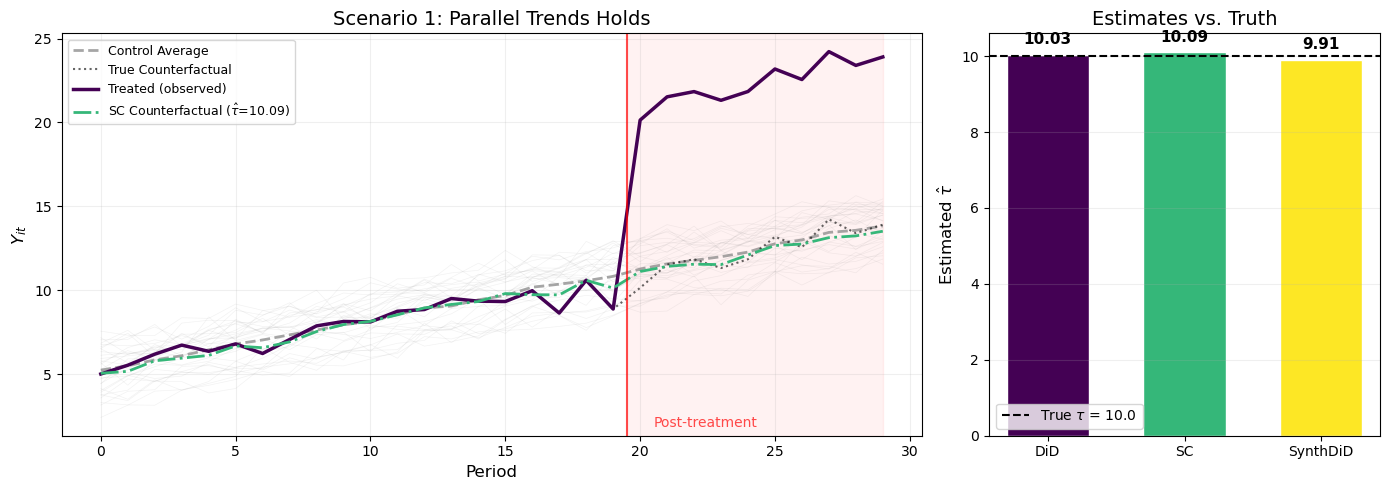
This is the textbook DiD setting: all units share the same time trend \delta_t, differing only in their levels \alpha_i. Parallel trends holds by construction, so DiD should perform well. SC and SynthDiD should also work, since the treated unit’s trajectory is easily matched by any convex combination of controls.
# Scenario 1: Parallel trends (gamma = 0 for all units)df1, info1 = generate_panel( N_co=30, T_pre=20, T_post=10, tau=10.0, alpha_tr=3.0, # within the control range [1, 5] gamma_co=None, # defaults to zeros gamma_tr=0.0, # no interactive FE sigma=0.5, seed=42,)results1 = estimate_all(df1, info1)print("="*50)print("Scenario 1: Parallel Trends Holds")print("="*50)print(f"True tau: {info1['tau']:.2f}")print(f"DiD: {results1['DiD']['tau']:.2f}")print(f"SC: {results1['SC']['tau']:.2f}")print(f"SynthDiD: {results1['SynthDiD']['tau']:.2f} (SE: {results1['SynthDiD']['se']:.2f})")
Figure 1: Scenario 1: When parallel trends holds, all three methods closely recover the true treatment effect.
As expected, when parallel trends holds, all three estimators closely recover the true treatment effect \tau = 10. The left panel of Figure 1 shows that the treated unit’s pre-treatment trajectory runs parallel to the control average — exactly the setting DiD was designed for. The SC counterfactual (green dash-dot line) tracks the true counterfactual (black dotted) closely as well.
The right panel confirms that all three estimates cluster tightly around the truth. This is the baseline: when your assumptions are satisfied, simpler methods work just fine.
Crucially, the treated unit’s level \alpha_{\text{tr}} = 3 remains within the convex hull of controls (\alpha_{\text{co}} \sim U[1, 5]), and its factor loading \gamma_{\text{tr}} = 2.5 is within the range of control loadings (\gamma_{\text{co}} \sim U[0, 3]).
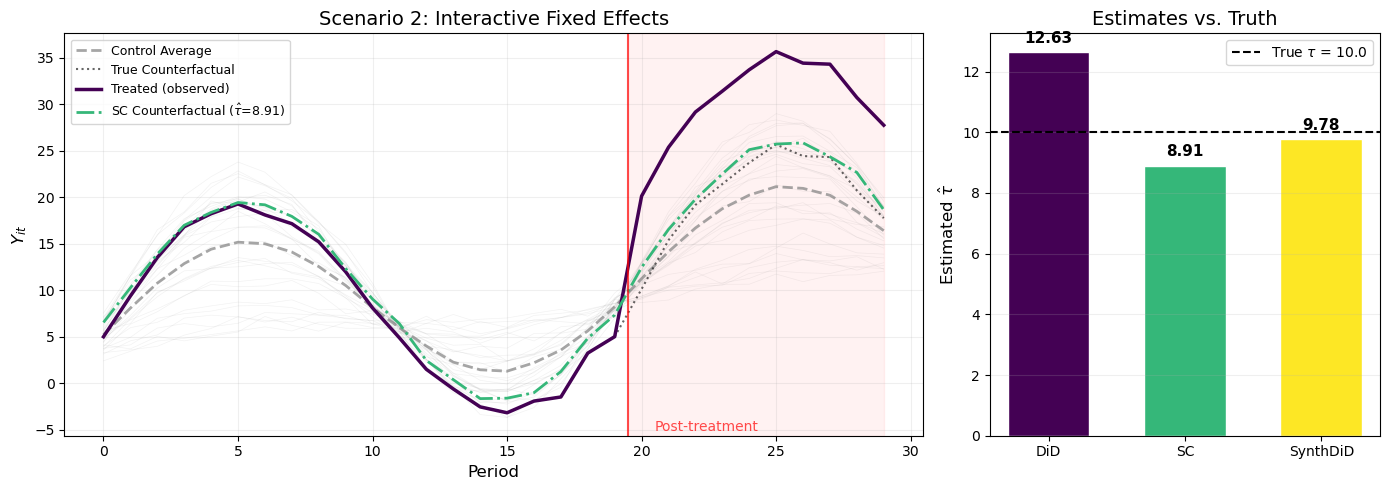
Since different units now follow different trends (depending on \gamma_i), parallel trends is violated. DiD should be biased. However, SC can construct a synthetic control that matches both the level and the factor loading of the treated unit, so it should recover the true effect.
# Scenario 2: Interactive FE, treated unit within convex hullrng2 = np.random.default_rng(42)gamma_co_2 = rng2.uniform(0, 3, 30) # control factor loadingsdf2, info2 = generate_panel( N_co=30, T_pre=20, T_post=10, tau=10.0, alpha_tr=3.0, # within control range gamma_co=gamma_co_2, # heterogeneous factor loadings gamma_tr=2.5, # within control range sigma=0.5, seed=42,)results2 = estimate_all(df2, info2)print("="*50)print("Scenario 2: Interactive Fixed Effects")print("="*50)print(f"True tau: {info2['tau']:.2f}")print(f"DiD: {results2['DiD']['tau']:.2f} (bias: {results2['DiD']['tau'] - info2['tau']:+.2f})")print(f"SC: {results2['SC']['tau']:.2f} (bias: {results2['SC']['tau'] - info2['tau']:+.2f})")print(f"SynthDiD: {results2['SynthDiD']['tau']:.2f} (bias: {results2['SynthDiD']['tau'] - info2['tau']:+.2f})")
Figure 2: Scenario 2: When parallel trends fails due to interactive fixed effects, DiD is biased while SC and SynthDiD recover the true effect.
Figure 2 tells a very different story from Scenario 1. The left panel shows that the treated unit (purple) no longer runs parallel to the control average (gray dashed) in the pre-treatment period — the trajectories visibly diverge due to the interactive fixed effects. The DiD counterfactual, which projects the control average’s change onto the treated unit, is therefore biased.
The SC counterfactual (green), by contrast, closely tracks the treated unit’s true counterfactual in both the pre- and post-treatment periods. This is because SC found a weighted combination of controls that matches the treated unit’s specific trajectory, including its factor loading.
The right panel confirms the key takeaway: DiD is substantially biased, while both SC and SynthDiD are close to the true \tau = 10. This is exactly the scenario that motivated synthetic control methods — when units follow different trends, equal-weighting all controls (as DiD does) gives the wrong answer.
2.4 Scenario 3: Interactive FE + Level Shift
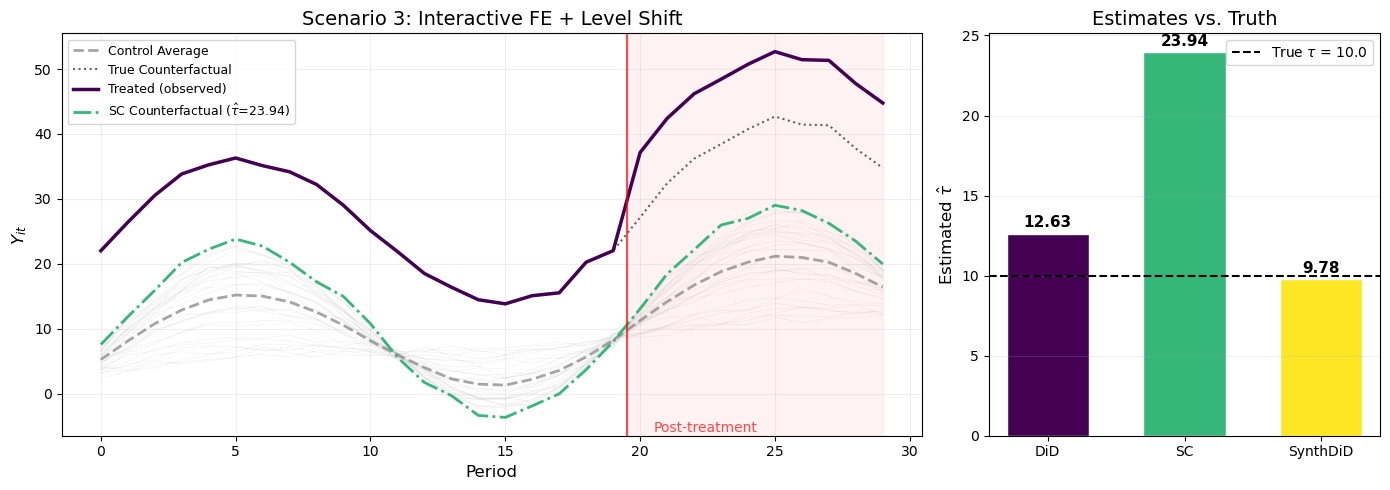
The final scenario combines interactive fixed effects with a level shift: the treated unit’s fixed effect \alpha_{\text{tr}} = 20 is far above the range of any control unit (\alpha_{\text{co}} \sim U[1, 5]):
DiD fails because parallel trends is violated (interactive FE).
SC fails because the treated unit’s level is outside the convex hull of controls. With weights constrained to the simplex (\omega \geq 0, \sum \omega = 1), SC cannot produce a synthetic control at level 20 from units at levels 1–5. It will try to match the level by putting all weight on the highest-level control, which may not have the right factor loading.
SynthDiD should handle both: its unit FE \alpha_i absorbs the level shift (like DiD), while the data-driven weights match the factor loading pattern (like SC).
# Scenario 3: Interactive FE + level shiftrng3 = np.random.default_rng(42)gamma_co_3 = rng3.uniform(0, 3, 30)df3, info3 = generate_panel( N_co=30, T_pre=20, T_post=10, tau=10.0, alpha_tr=20.0, # FAR outside control range [1, 5] gamma_co=gamma_co_3, # heterogeneous factor loadings gamma_tr=2.5, # within control range sigma=0.5, seed=42,)results3 = estimate_all(df3, info3)print("="*50)print("Scenario 3: Interactive FE + Level Shift")print("="*50)print(f"True tau: {info3['tau']:.2f}")print(f"DiD: {results3['DiD']['tau']:.2f} (bias: {results3['DiD']['tau'] - info3['tau']:+.2f})")print(f"SC: {results3['SC']['tau']:.2f} (bias: {results3['SC']['tau'] - info3['tau']:+.2f})")print(f"SynthDiD: {results3['SynthDiD']['tau']:.2f} (bias: {results3['SynthDiD']['tau'] - info3['tau']:+.2f})")
plot_scenario(info3, results3, 'Scenario 3: Interactive FE + Level Shift')
Figure 3: Scenario 3: With both interactive fixed effects and a level shift, only SynthDiD recovers the true treatment effect.
Figure 3 illustrates the scenario where SynthDiD shines. The left panel shows a dramatic level gap between the treated unit (purple, at ~Y \approx 25) and the control units (gray, clustered around Y \approx 5–12). The SC counterfactual (green) cannot reach the treated unit’s level — it is forced to stay within the convex hull of control outcomes.
The right panel makes the failure modes clear:
DiD is biased by the interactive fixed effects (same issue as Scenario 2).
SC is biased because the level shift distorts the weights: instead of matching the factor loading \gamma_{\text{tr}} = 2, SC puts all weight on the control unit with the highest level, which may have a very different \gamma_i.
SynthDiD absorbs the level shift via its intercept (unit FE) and matches the factor loading via data-driven weights, recovering a much more accurate estimate.
This is the core insight of Arkhangelsky et al. (2021): by combining DiD’s intercept adjustment with SC’s data-driven weighting, SynthDiD is robust to both level shifts and non-parallel trends.
2.5 Monte Carlo Comparison
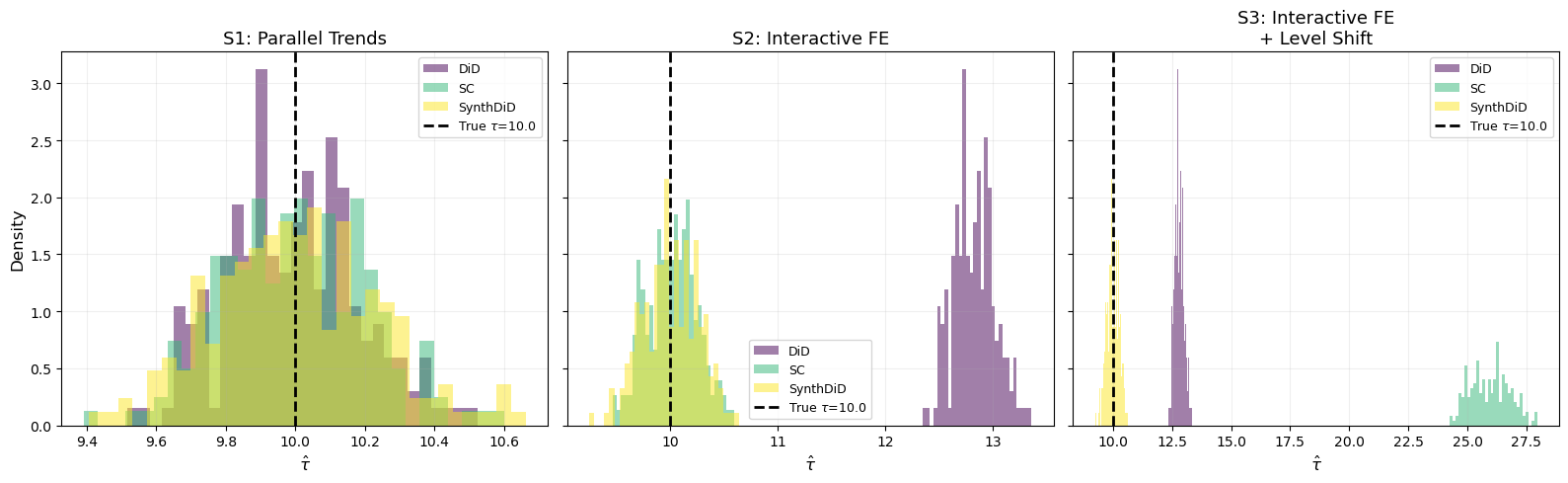
The single realizations above are illustrative, but they depend on a particular draw of \varepsilon_{it}. To confirm that the patterns are robust, we run a small Monte Carlo experiment: 200 replications of each scenario, varying only the noise draws.
n_mc =200tau_true =10.0# Pre-draw fixed control loadings (same across MC runs, only noise varies)rng_mc = np.random.default_rng(0)gamma_co_mc = rng_mc.uniform(0, 3, 30)scenarios = {'S1: Parallel Trends': {'alpha_tr': 3.0, 'gamma_co': np.zeros(30), 'gamma_tr': 0.0, },'S2: Interactive FE': {'alpha_tr': 3.0, 'gamma_co': gamma_co_mc, 'gamma_tr': 2.5, },'S3: Interactive FE\n+ Level Shift': {'alpha_tr': 20.0, 'gamma_co': gamma_co_mc, 'gamma_tr': 2.5, },}mc_results = {s: {m: [] for m in ['DiD', 'SC', 'SynthDiD']} for s in scenarios}for s_name, s_params in scenarios.items():print(f"Running MC for {s_name}...", end=" ")for i inrange(n_mc): df_mc, info_mc = generate_panel( N_co=30, T_pre=20, T_post=10, tau=tau_true, alpha_tr=s_params['alpha_tr'], gamma_co=s_params['gamma_co'], gamma_tr=s_params['gamma_tr'], sigma=0.5, seed=1000+ i, ) Y_mc = info_mc['Y'] N_co_mc = info_mc['N_co'] T_pre_mc = info_mc['T_pre']# DiD tau_did, _ = estimate_did_manual(Y_mc, N_co_mc, T_pre_mc) mc_results[s_name]['DiD'].append(tau_did)# SC tau_sc, _, _ = estimate_sc_manual(Y_mc, N_co_mc, T_pre_mc) mc_results[s_name]['SC'].append(tau_sc)# SynthDiD post_periods =list(range(T_pre_mc, T_pre_mc + info_mc['T_post']))try: sdid = SyntheticDiD(seed=i) sdid_res = sdid.fit( df_mc, outcome='y', treatment='treated', unit='unit', time='period', post_periods=post_periods, ) mc_results[s_name]['SynthDiD'].append(sdid_res.att)exceptException: mc_results[s_name]['SynthDiD'].append(np.nan)print("done.")print("\nMonte Carlo complete.")
Running MC for S1: Parallel Trends... done.
Running MC for S2: Interactive FE... done.
Running MC for S3: Interactive FE
+ Level Shift... done.

Monte Carlo complete.
Table 1: Monte Carlo results: Bias, RMSE, and coverage across 200 replications.
Mean $\hat{\tau}$
Bias
RMSE
Scenario
Method
S1: Parallel Trends
DiD
9.993
-0.007
0.190
SC
9.999
-0.001
0.208
SynthDiD
10.004
0.004
0.232
S2: Interactive FE
DiD
12.824
2.824
2.831
SC
10.019
0.019
0.230
SynthDiD
10.005
0.005
0.255
S3: Interactive FE + Level Shift
DiD
12.824
2.824
2.831
SC
25.966
15.966
15.987
SynthDiD
10.005
0.005
0.255
The Monte Carlo results in Figure 4 and Table 1 confirm the patterns from the single realizations:
Scenario 1 (Parallel Trends): All three methods are approximately unbiased. DiD has the lowest RMSE, reflecting its efficiency advantage when its assumptions hold.
Scenario 2 (Interactive FE): DiD shows substantial bias, while SC and SynthDiD remain well-centered at \tau = 10. SC has slightly lower RMSE because it doesn’t need to estimate time weights.
Scenario 3 (Interactive FE + Level Shift): Both DiD and SC are biased — DiD due to non-parallel trends, SC due to the level shift breaking the convex hull condition. Only SynthDiD remains approximately unbiased, demonstrating its robustness.
The key takeaway: SynthDiD is the only method that performs well across all three scenarios. It is never the single best performer (DiD wins in Scenario 1, SC ties it in Scenario 2), but it is never badly biased either. This “minimax” property — avoiding the worst case rather than optimizing for the best case — is precisely the motivation of Arkhangelsky et al. (2021).
3 Real-World Application
Coming soon. In a follow-up section, we will apply DiD, SC, and SynthDiD to a real policy evaluation dataset — comparing the estimated treatment effects and examining how the choice of method affects the conclusions.
Candidate datasets include: - California’s Proposition 99 (tobacco tax) — the classic synthetic control application from Abadie et al. (2010) - German reunification — Abadie et al. (2015) - Castle Doctrine laws (available in diff-diff via load_castle_doctrine())
4 Conclusions
In this post, we compared three cornerstone methods for causal inference with aggregate data — Difference-in-Differences, Synthetic Control, and Synthetic Difference-in-Differences — through the lens of the unified framework from Arkhangelsky et al. (2021).
Key takeaways:
All three methods are special cases of a weighted TWFE regression, differing only in their choice of unit weights \hat{\omega}_i and time weights \hat{\lambda}_t. This unification reveals exactly which assumptions each method relies on.
DiD is efficient when parallel trends holds (Scenario 1), but breaks down when units follow heterogeneous trends (Scenarios 2–3). Its uniform unit weights cannot adapt to differential factor loadings.
SC handles non-parallel trends by matching the treated unit’s pre-treatment trajectory (Scenario 2), but fails when a level shift puts the treated unit outside the convex hull of controls (Scenario 3). Without an intercept, SC tries to match levels through the weights, distorting the factor loading match.
SynthDiD provides the best of both worlds: it absorbs level shifts via unit fixed effects (like DiD) while using data-driven unit weights to match factor loadings (like SC). Additionally, its time weights focus on the most informative pre-treatment periods. As a result, it is the only method that performs well across all three scenarios.
The diff-diff Python package provides a comprehensive implementation of SynthDiD and many other modern DiD estimators, making these methods easily accessible for applied work.
5 References
Arkhangelsky, D., Athey, S., Hirshberg, D. A., Imbens, G. W., & Kellogg, S. (2021). Synthetic Difference-in-Differences. American Economic Review, 111(12), 4088–4118.
Abadie, A., Diamond, A., & Hainmueller, J. (2010). Synthetic Control Methods for Comparative Case Studies: Estimating the Effect of California’s Tobacco Control Program. Journal of the American Statistical Association, 105(490), 493–505.
Abadie, A., Diamond, A., & Hainmueller, J. (2015). Comparative Politics and the Synthetic Control Method. American Journal of Political Science, 59(2), 495–510.
Abadie, A. (2021). Using Synthetic Controls: Feasibility, Data Requirements, and Methodological Aspects. Journal of Economic Literature, 59(2), 391–425.
Gerber, I. (2025). diff-diff: A comprehensive Python package for Difference-in-Differences. GitHub.